
Move with clarity. Adapt with confidence. Pivot with purpose.
In a world where customer needs shift overnight and competitors innovate at speed, organizations can’t afford static roadmaps or rigid plans. Purposeful Pivoting ensures that strategy is not an annual ritual — it’s a living flow that guides decisions, prioritization, and adaptation.
The Direction Flow is where every transformation begins.
🚨 The Problem It Solves
Most organizations don’t struggle because of lack of effort — they struggle because of misaligned effort.
Common symptoms include:
- Teams working hard but not towards the same outcomes
- Late, reactive pivots driven by panic, not purpose
- Projects continuing even when signals show they should stop
- Leaders making decisions with outdated information
- Strategy that lives in decks, not in day-to-day work
Purposeful Pivoting fixes this by aligning strategy, decisions, and actions to a clear, evolving purpose.
🌟 What This Flow Is
The Direction Flow is the flow of purpose, clarity, and strategic adaptability.
It ensures that:
- Every initiative ties back to a shared purpose
- Teams know not only what they’re doing but why
- Course corrections happen early — before waste accumulates
- Strategy evolves continuously with market and customer signals
- Leaders and teams stay aligned without micromanagement
In short:
👉 Everyone moves in the same direction, even as the path changes.
✨ Core Principles of Purposeful Pivoting
1. Direction > Perfection
Waiting for perfect clarity slows organizations down.
Direction Flow emphasizes being directionally correct, making decisions with available information, and adjusting as new insights emerge.
You move fast and stay aligned.
2. Sensing Mechanisms
Pivots shouldn’t be emotional reactions.
They should be triggered by signals from:
- Customer feedback
- Usage patterns
- Market shifts
- Technology disruption
- Team capacity and health
You don’t guess — you sense, interpret, and act.
3. Small Bets, Big Learning
Instead of big gambles → run small experiments.
Test hypotheses quickly. Learn fast.
A pivot is successful not when it’s right, but when it reduces risk and reveals truth.
Purposeful Pivoting embraces continuous micro-adjustments, not occasional big-bang changes.
🛠️ Practices That Bring This Flow to Life
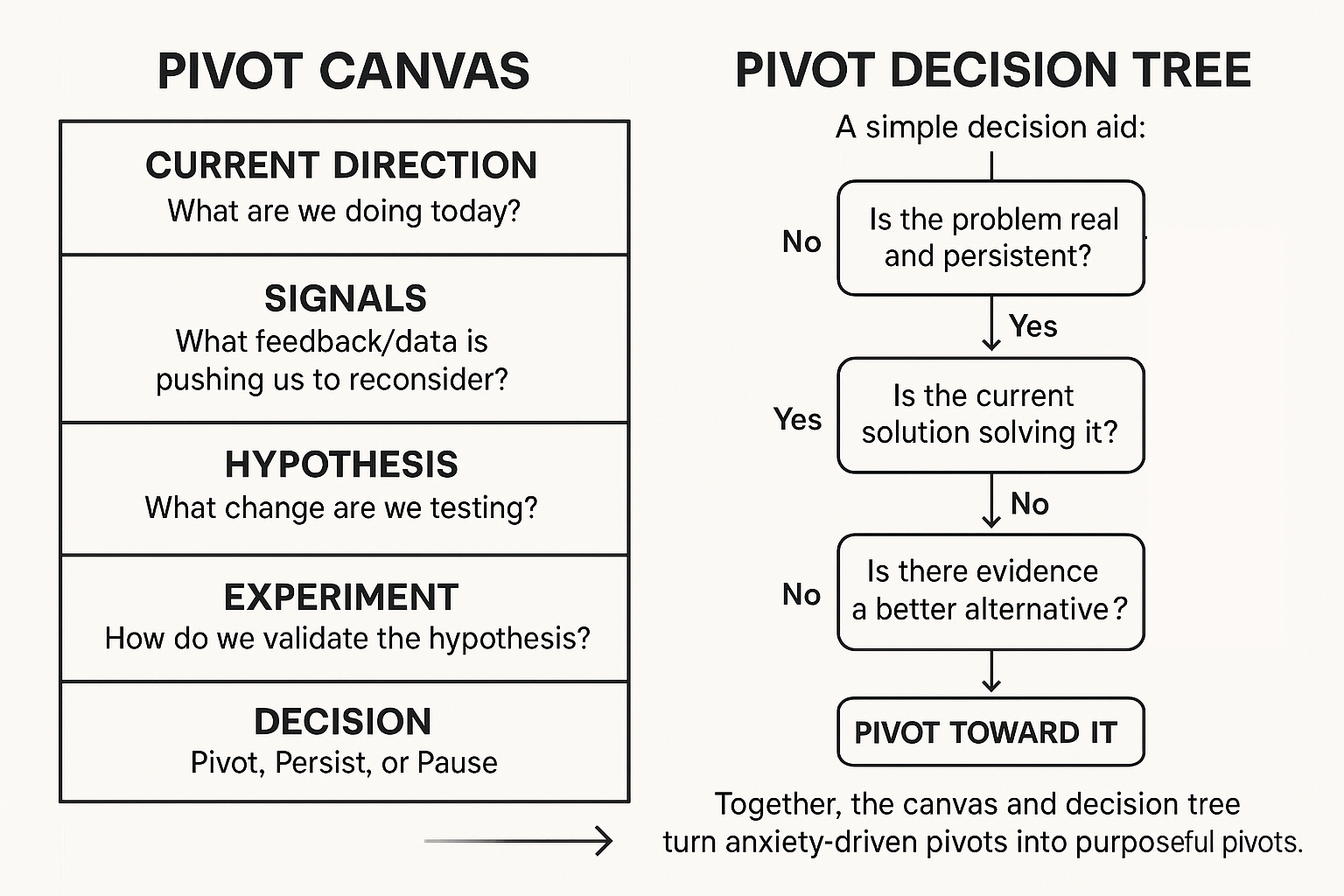
1. The Pivot Canvas
A practical template to evaluate whether to persist, pivot, or pause.
It helps teams analyze:
- What problem we are solving
- What signals we’re observing
- What assumptions need testing
- Options for reframing or repositioning
This removes emotion from decisions and brings structure to adaptation.
2. Pivot Decision Tree
A simple decision flowchart that guides teams when facing uncertainty.
Questions like:
- Has the customer signal changed?
- Are metrics validating our assumptions?
- Is the market moving in a new direction?
- Do we have enough evidence to scale?
It ensures pivots are purposeful, not impulsive.
3. Pivot Council (Monthly / Quarterly)
A lightweight governance ritual where leaders and product teams come together to review:
- Market signals
- OKR progress
- Experiment outcomes
- Emerging opportunities
- Items to pivot, persist, or prune
It replaces heavy steering committees with fast, data-informed decisions.
📡 Signals & Triggers: When to Pivot
Purposeful pivots are triggered by evidence, not emotion.
Some common triggers include:
Customer Signals
- Drop in usage or engagement
- Rising churn
- Negative feedback patterns
- Requests for features outside current strategy
Market Signals
- New competitor features or pricing models
- Industry disruption
- Regulatory shifts
- Emerging customer segments
Technology Signals
- AI breakthroughs
- Platform limitations
- New integration opportunities
Team Signals
- Overload or burnout
- Skills mismatch
- Delays caused by dependencies
Outcome Signals
- Key results not moving
- Poor ROI
- Delayed time-to-impact
Purposeful Pivoting makes these signals visible so decisions are clear.
📘 Real Example: Slack’s Purposeful Pivot
Slack didn’t start as a messaging platform. It began as a gaming company (Tiny Speck).
The game struggled — but something unusual was happening.
Signals:
- Game traction was low
- Users weren’t sticking
- The internal chat tool was being used heavily
- Early testers loved the messaging experience
Hypothesis:
“What if the real value we’re building is not the game… but the communication tool?”
Experiment:
- Share internal chat tool with external groups
- Collect usage and engagement patterns
- Compare traction vs. the game
Result:
- The chat tool showed strong evidence of product–market fit
- The game did not
- The company pivoted
- Slack went on to become a global SaaS powerhouse, later acquired for $27.7B
Lesson:
A pivot is not failure — it is purposeful evolution.
Slack listened to signals, tested hypotheses, and aligned strategy with real customer value.
🧰 Tools Linked to This Flow
These tools help teams sense, decide, and adapt continuously:
✔ Value Alignment Canvas
Align purpose → themes → OKRs → metrics.
(Connects direction to delivery.)
✔ Pivot Canvas
Structure strategic decisions with clarity.
✔ Pivot Decision Tree
Turn uncertainty into informed action.