
Empowered teams. Aligned purpose. Continuous ownership.
In ValueFlow, people are not resources — they are value creators.
The People Flow focuses on building empowered, cross-functional squads that own outcomes end-to-end. When teams have clarity, autonomy, and safety, value flows faster and more sustainably.
Autonomous Squads are the smallest, most powerful unit of value delivery in the ValueFlow Framework.
🚨 The Problem It Solves
Many organizations suffer from:
- Siloed functional teams (Dev, QA, Ops, UX working separately)
- Endless handoffs and dependencies
- Micromanagement and top-heavy decision-making
- Lack of ownership (“we delivered what was asked, not what was needed”)
- Teams that disband after projects, losing knowledge
- Slow responses to customer or market changes
These issues break the flow of value.
People Flow solves this by building small, persistent, cross-functional teams that own outcomes — not tasks.
🌟 What This Flow Is
Autonomous Squads are:
- Small teams (6–9 members)
- Cross-functional (design, engineering, QA, data, domain experts)
- Mission-driven (own a customer problem or product area)
- Empowered to decide how to solve problems
- Accountable for outcomes across the product lifecycle
This flow creates a structure where value can move end-to-end without friction.
The People Flow connects directly with Purposeful Pivoting:
👉 When strategy shifts, squads adapt quickly because they own the whole problem, not a small part of it.
✨ Core Principles of the People Flow
1. Autonomy with Alignment
Autonomy does not mean “do whatever you want.”
Autonomy means teams are free to decide how they deliver, while staying fully aligned with purpose, outcomes, and guardrails.
Alignment gives direction.
Autonomy gives speed.
2. End-to-End Ownership
Squads don’t just build features — they own the product experience from ideation to evolution.
This eliminates handoffs and increases accountability.
Ownership creates pride, clarity, and momentum.
3. Psychological Safety
Innovation thrives where people feel safe to:
- Experiment
- Challenge assumptions
- Admit failures
- Learn rapidly
People Flow encourages leaders to shift from micromanagers → coaches.
4. Capability Over Capacity
Traditional models ask: “How much work can we squeeze in?”
ValueFlow asks: “How do we build team capability so they can solve bigger problems?”
Skilling > Speed
Learning > Load
Mastery > Multitasking
This mindset builds resilient, high-performing squads.
🧱 The Core Structures That Enable People Flow
ValueFlow draws from the best of Spotify and Team Topologies, adapted for real-world execution.
✔ Squads
The smallest value-delivery unit.
Own a customer problem, value stream, or product area.
✔ Tribes
A group of squads working in the same domain (e.g., “Customer Experience Tribe”).
Ensures alignment and shared understanding across related product areas.
✔ Chapters
Communities of people with similar skills (e.g., QA Chapter, Design Chapter).
They nurture craft excellence across squads.
✔ Guilds
Informal, passion-based groups (e.g., AI Guild, Accessibility Guild).
They spread ideas, innovation, and best practices.
These structures allow squads to stay small and autonomous, while the organization remains highly aligned and loosely coupled.
🛠️ Practices That Bring People Flow to Life
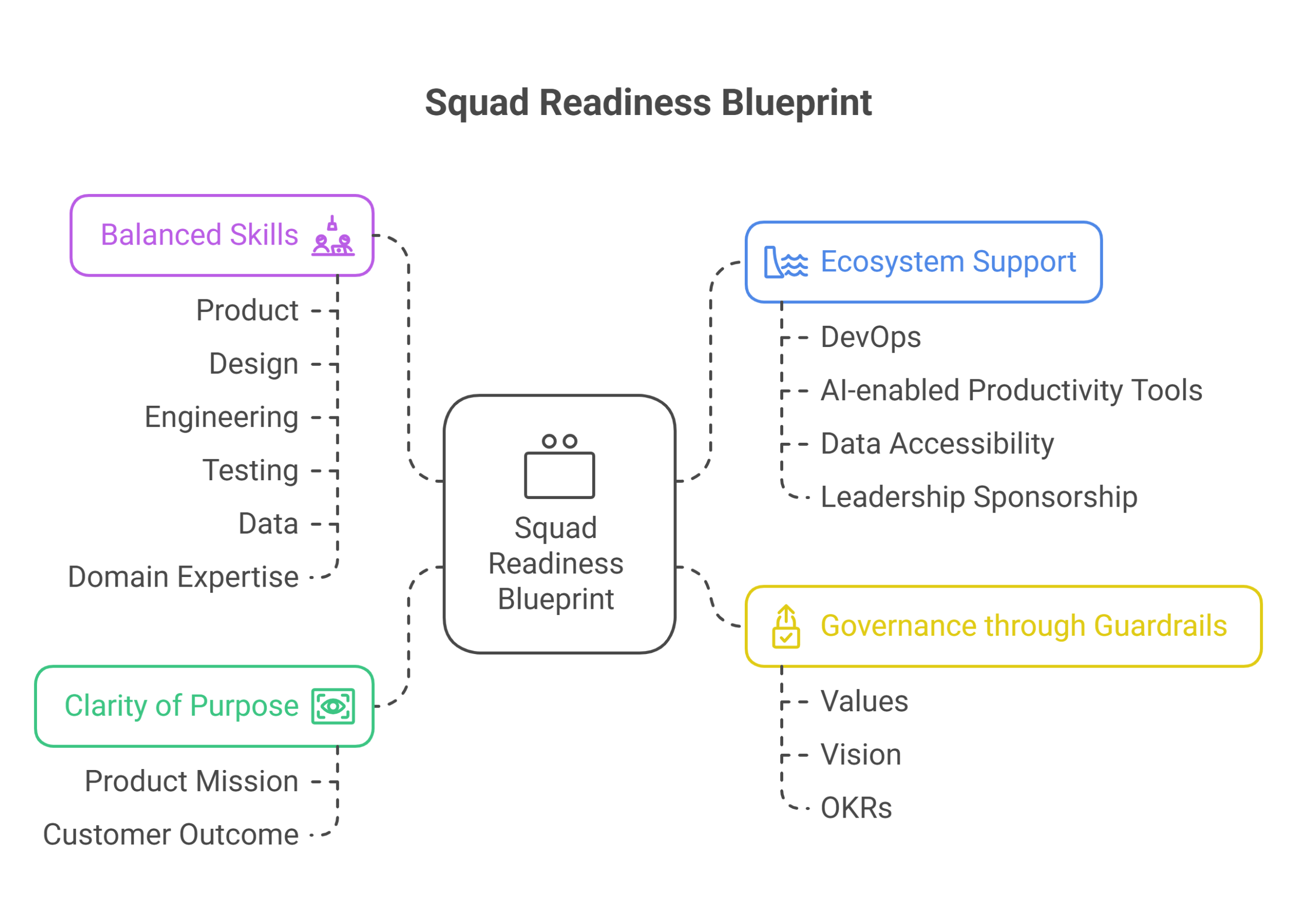
1. Squad Readiness Blueprint
A diagnostic tool to assess whether a team is truly ready to operate as a squad.
It checks:
- Purpose clarity
- Skill balance
- Decision-making autonomy
- Technical enablement
- Psychological safety
- Support ecosystem (DevOps, AI tools, product management)
If a squad fails readiness — we fix the system, not the people.
2. Team Topology Mapper
A visual tool for designing squads around value streams, not org charts.
Maps your teams into one of four shapes:
- Stream-aligned teams
- Enabling teams
- Complicated subsystem teams
- Platform teams
It ensures that squads own the right slice of value and aren’t overloaded.
3. Community Structures (Tribes, Chapters, Guilds)
These structures create:
- Skill sharing
- Cultural alignment
- Practice evolution
- Healthy debate
- Cross-pollination of innovation
They prevent silos while maintaining autonomy.
📡 Signals & Triggers for People Flow
A shift to Autonomous Squads is needed when you observe:
- Teams waiting on approvals or escalations
- Frequent handoffs causing delays
- Conflicting priorities among teams
- Lack of clarity on who owns what
- Overloaded leaders making all decisions
- Rework due to misalignment
- Burnout from excessive multitasking
Autonomous Squads restore speed, clarity, and ownership.
📘 Real Example: Spotify’s Autonomous Squad Model
(from your ebook)
Spotify reorganized into small, self-organizing squads to solve bottlenecks caused by growth.
Challenges They Faced:
- Innovation slowing due to hierarchy
- Teams dependent on each other for every release
- Hard to scale culture and engineering practices
- Slow decision-making at higher levels
Hypothesis:
“If teams are given clear missions, autonomy, and lightweight alignment structures, innovation will accelerate.”
Experiments:
- Created small squads with end-to-end ownership
- Let squads choose their own agile practices
- Introduced tribes for alignment
- Introduced chapters and guilds for skill consistency
- Leaders shifted from controllers → coaches
Result:
- Faster decisions
- Rapid release cycles
- Higher employee engagement
- High alignment with low bureaucracy
- Model became globally influential
Lesson:
Autonomy scales innovation — when alignment is strong, teams become unstoppable.
🧰 Tools Linked to This Flow
✔ Squad Readiness Blueprint
Determine if your teams are ready for autonomous ownership.
✔ Team Topology Mapper
Design teams around value streams, not silos.
✔ Tribe & Chapter Playbook
Set up communities that maintain alignment and craft excellence.
✔ Role Clarity Canvas
Ensure everyone knows ownership, responsibilities, and decision rights.
✔ People Flow Maturity Assessment
Check autonomy, safety, skills, and alignment.