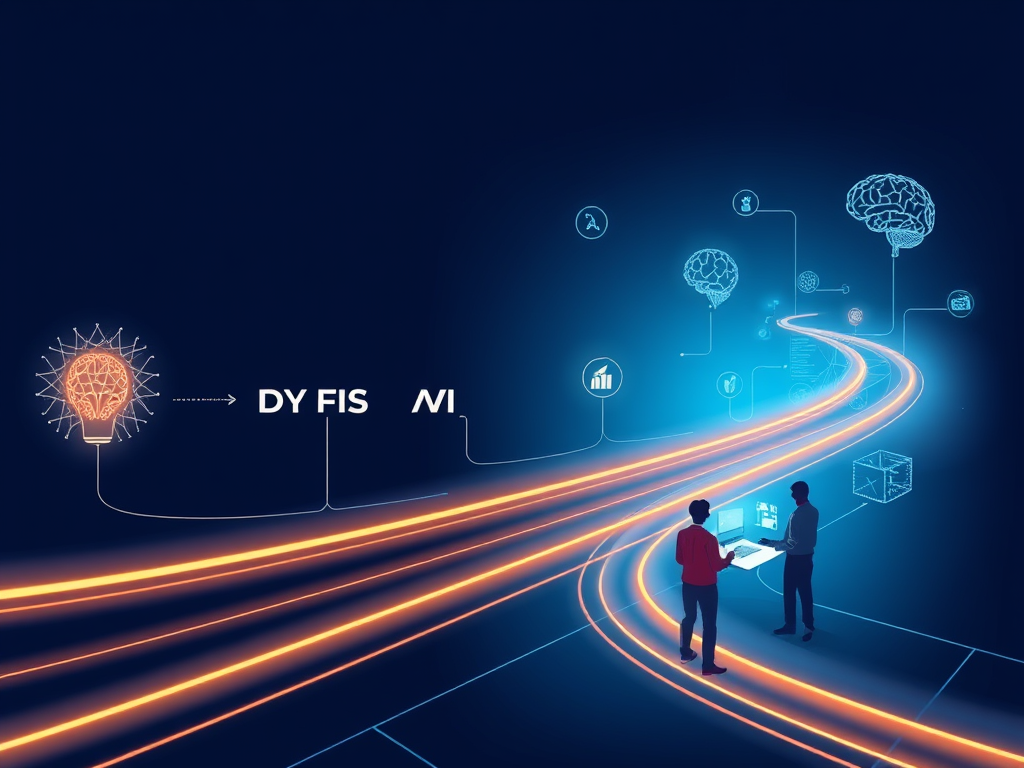
Not long ago, Agile teams relied almost entirely on manual work: writing user stories, digging for customer insights, estimating effort, analyzing feedback, and running endless meetings to align decisions.
Today, the landscape has shifted.
Generative AI is no longer a cool add-on — it has quietly become the new backbone of modern product teams.
Teams that embrace AI aren’t replacing people.
They are reducing friction, boosting clarity, and accelerating flow — the same flow that every product transformation aspires to achieve.
This is the world of AI-enabled agility.
A world where discovery is faster, delivery is smoother, and decisions are sharper.
Let’s explore how teams are using AI across the product lifecycle, and what it really looks like in day-to-day practice.
Where AI Fits into Modern Product Workflows
AI doesn’t magically solve problems.
But it dramatically reduces the time teams spend on:
✔ Data gathering
✔ Analysis
✔ Content creation
✔ Refinement
✔ Repetition
✔ Alignment
In other words, AI removes the noise — so human teams can focus on judgment, creativity, and empathy.
Here are the five major areas where AI is reshaping Agile product delivery.
1. AI in Discovery: Turning Data Into Direction
Discovery has always been messy.
Customer interviews, scattered feedback, analytics dashboards, competitor insights — everything comes in fragmented pieces.
AI now plays the role of a “discovery accelerator.”
How AI Helps:
- Clusters customer feedback into themes
- Generates insight summaries
- Detects patterns in usage data
- Highlights unmet needs
- Analyzes competitor moves
- Suggests problem statements and opportunities
Real Scenario #1:
A SaaS team used AI to scan 12,000 customer tickets.
In minutes, AI surfaced:
- a recurring pattern of onboarding confusion,
- friction around trial-to-paid conversion, and
- underused features.
This became the basis for their next three sprints — something that would’ve taken weeks manually.
Outcome:
A 21% increase in onboarding completion within one quarter.
2. AI in Backlog Refinement: From Chaos to Clarity
Backlogs often grow into unmanageable lists of ideas, requests, and half-written stories.
AI helps teams organize, rewrite, and prioritise with extraordinary speed.
How AI Helps:
- Converts raw notes into well-formatted user stories
- Suggests acceptance criteria
- Groups items into epics
- Removes duplicates
- Offers impact/effort suggestions
- Helps identify missing dependencies
Real Scenario #2:
A product manager uploaded a 40-page workshop transcript into an AI tool.
Within seconds, the AI generated:
- 27 clean user stories
- 5 epics
- Priority suggestions
- Clear acceptance criteria
- Risks & assumptions
The PM said it replaced “three refinement meetings worth of work.”
3. AI in Prototyping: Ideas to Visuals in Minutes
Previously, product teams waited days or weeks for designers to transform ideas into prototypes.
AI now enables rapid design exploration.
How AI Helps:
- Creates UI mockups from text prompts
- Produces multiple design variations
- Generates landing page concepts
- Suggests interaction flows
- Helps teams visualize complex ideas instantly
Real Scenario #3:
A fintech startup used AI to generate 10 UI variations for a new payments dashboard.
The designer refined the best one into a production-ready prototype.
Time saved:
A full sprint.
Impact:
Faster testing with customers → faster decisions → faster delivery.
4. AI in Sprint Planning: Better Estimates, Smarter Plans
Sprint planning often relies on human memory and gut feel.
AI adds data-backed clarity.
How AI Helps:
- Suggests story point ranges
- Predicts workload balance
- Highlights potential bottlenecks
- Recommends sprint goals based on recent progress
- Generates capacity-adjusted plans
Real Scenario #4:
A distributed team fed previous sprint data into their AI assistant.
AI highlighted that:
- QA was overloaded
- the team had 18% fewer hours due to holidays
- certain tasks were likely to spill over
The team adjusted the scope and, for the first time in 5 sprints, hit all their sprint goals.
5. AI in Continuous Improvement: Insights That Help Teams Grow
AI becomes the team’s neutral observer — giving data-backed insights without emotional bias.
How AI Helps:
- Summarizes retrospectives
- Identifies systemic blockers
- Tracks improvement actions
- Predicts cycle time changes
- Flags team health risks
Real Scenario #5:
An e-commerce team used AI-based analysis of sprint data.
AI detected:
- high context-switching
- disproportionate bug load on two developers
- increased cycle time in the last three sprints
This insight led to a restructuring of work distribution — and a 30% improvement in flow.
What AI-Enabled Teams Actually Look Like
AI doesn’t replace Agile.
It supercharges it.
Teams using AI show clear behavioral changes:
- They spend less time documenting and more time problem-solving.
- They validate ideas faster, often in hours.
- They align decisions quickly with more confidence.
- Their backlog is always clean and actionable.
- They deliver smaller, better increments.
- They connect decisions to data instead of assumptions.
In other words:
AI restores the true spirit of agility — focus on value, learning, and flow.
Does AI Replace People? Absolutely Not.
AI handles the repetitive, analytical, and translation tasks.
Humans handle the judgment, empathy, storytelling, vision, and leadership.
Think of it as a team member who never gets tired,
never loses track of details,
and never stops learning.
AI amplifies people — it doesn’t diminish them.
Stepping Into the Future: AI-Enabled Agility as a Competitive Advantage
Organizations that adopt AI-enabled agility now are positioning themselves far ahead of competitors.
They will:
- innovate faster,
- understand customers better,
- reduce waste,
- make better decisions, and
- accelerate meaningful value delivery.
This is not a trend.
This is the new operating model.
And teams that embrace it early will define the future of product-led growth.
Final Thoughts: Agility Was Always About Flow — AI Just Makes It Faster
The real power of AI lies not in automation, but in amplification.
It takes the best parts of Agile — discovery, collaboration, learning, and iteration —
and removes the delays that hold teams back.
AI-enabled agility is not about doing more.
It’s about doing what matters, with clarity and purpose.
And for organizations ready to evolve, this is the biggest opportunity of the decade.