
Where motivation meets momentum.
Where transformation becomes a game worth playing.
Every transformation rises or falls on one factor: people’s energy.
Not budgets.
Not tools.
Not plans.
If people are not engaged, no framework survives.
If people are energized, even imperfect systems thrive.
The Energy Flow brings the psychology of play, behavioral science, and intrinsic motivation into the heart of your organizational transformation.
🚨 The Problem It Solves
Most organizations don’t fail at transformation because of process issues — they fail because of engagement issues:
- Teams feel change is “extra work,” not meaningful work
- Leaders push compliance rather than inspire participation
- Motivation drops after initial excitement
- Training and adoption fade over time
- Employees feel unseen, unrecognized, or undervalued
- Continuous improvement feels tiring, not energizing
- Innovation is treated as a “special event,” not a habit
This leads to fatigue, resistance, and apathy — the silent killers of transformation.
Energy Flow solves this by turning engagement into a designed, measurable, continuous experience.
🌟 What This Flow Is
Gamified Engagement is not about making work childish — it’s about making work feel meaningful, visible, rewarding, and energizing.
Energy Flow uses game mechanics, intrinsic motivators, competition, collaboration, and narrative to keep teams excited to participate.
It turns transformation from a push → into a pull.
✨ Core Principles of the Energy Flow
1. Engagement Over Compliance
People don’t resist change — they resist being forced to change.
Gamification makes transformation something people want to be part of.
2. Intrinsic Motivation > Extrinsic Rewards
Points and badges create excitement.
But mastery, autonomy, purpose, and belonging create sustained engagement.
Energy Flow balances both.
3. Design for Players, Not Processes
Transformation should be designed around:
- What motivates your people
- What inspires friendly competition
- What sparks curiosity
- What builds community
People are the players.
Culture is the game.
4. Narrative Drives Momentum
Every great game has a story.
So does every great transformation.
Energy Flow creates shared quests, missions, and journeys that give meaning to everyday work.
🛠️ Practices That Bring Energy Flow to Life
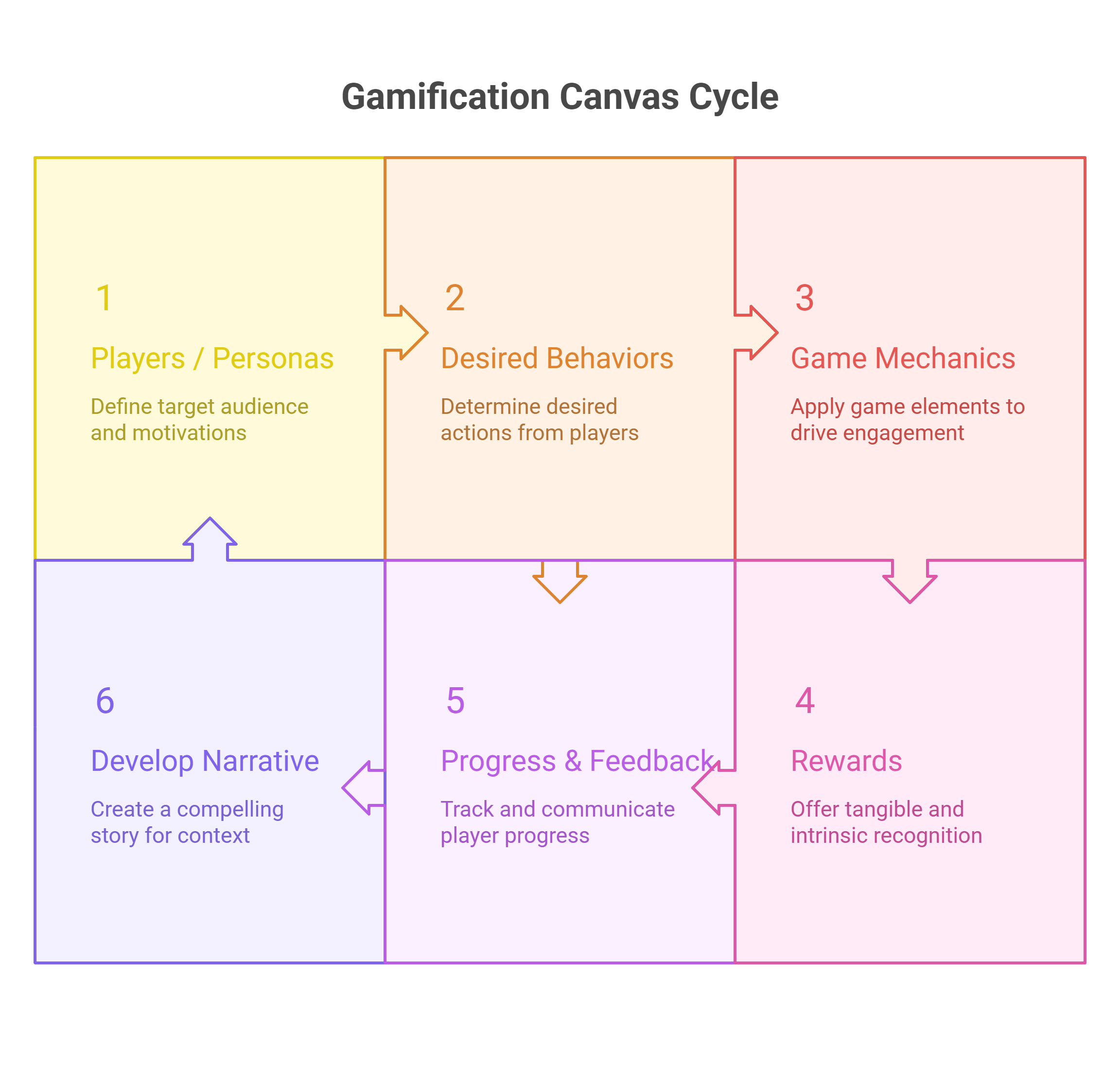
1. Gamification Design Canvas
A structured way to design engagement mechanics for teams, tribes, or entire organizations.
It helps define:
- Who are the players?
- What behaviors do we want?
- What mechanics drive those behaviors?
- What rewards reinforce them?
This keeps gamification intentional, not gimmicky.
2. Innovation Sprint Board
A playful, gamified board for running innovation cycles.
Lanes include:
- Treasure Chest (Idea Backlog)
- Quest Accepted (Selected Experiments)
- Arena (Prototyping & Testing)
- Scoreboard (Learnings & Insights)
- Level Up (Scale, Persevere, Prune)
Teams win points for clarity, creativity, collaboration, and validated learning.
It makes innovation fun, not fearful.
3. Points, Badges, Levels & Leaderboards
When used responsibly, these create:
- Positive peer pressure
- Recognition
- Friendly competition
- Celebration of progress
- Skill mastery visibility
Energy Flow uses these to reinforce culture — not as superficial rewards.
4. Engagement Rituals
Playful rituals bind teams:
- Weekly “Wins & Wonders”
- Badge ceremonies
- Peer recognition shout-outs
- Quest launches
- Level-up celebrations
- “Guild challenges” across squads
They create emotional connection and momentum.
📡 Signals & Triggers for Energy Flow
Organizations need Gamified Engagement when they observe:
- Drops in team motivation
- People viewing transformation as “extra work”
- Slow adoption of new practices
- Low participation in retros, feedback, or learning loops
- Friction between teams or roles
- Declining creativity or experimentation
- Fatigue from too many initiatives
- Resistance to change
Energy Flow revives morale and sustains momentum.
📘 Real Example: Duolingo’s Gamified Engagement Engine
Duolingo revolutionized language learning through gamification.
Challenges They Faced:
- High dropout rates in early weeks
- Low motivation for long-term learning
- Traditional app models felt boring and uninspiring
Hypothesis:
“If we reward progress, build streaks, and create playful competition, learners will stay motivated longer.”
Experiments:
- Introduced XP points
- Added streaks for daily activity
- Created leaderboards and leagues
- Designed progress levels and badges
- Ran A/B tests to optimize mechanics
Results:
- 20M+ daily active users
- Learners with streaks were 3× more likely to stay active
- Massive long-term retention
- IPO at $6B valuation
Lesson:
Gamification drives habits.
People stick with what feels rewarding, visible, and fun.
Energy Flow applies the same principles to workplace transformation.
🧰 Tools Linked to This Flow
✔ Gamification Design Canvas
Design intrinsic and extrinsic motivators intentionally.
✔ Innovation Sprint Board
Run fun, fast-paced experiments that encourage learning and creativity.
✔ Engagement Mechanic Toolkit
Points, badges, levels, quests, and leaderboards.
✔ Energy Flow Assessment
Gauge team motivation, morale, and engagement health.
✔ Reward Mechanism Matrix
Balance short-term excitement with long-term purpose.